D^2-4DGS: Dual-Depth Guided Sparse-Camera 4D Gaussian Splatting
作者: Jijian Zhao
单位: Huazhong University of Science and Technology
会议: 2026 Arxiv
链接: arXiv
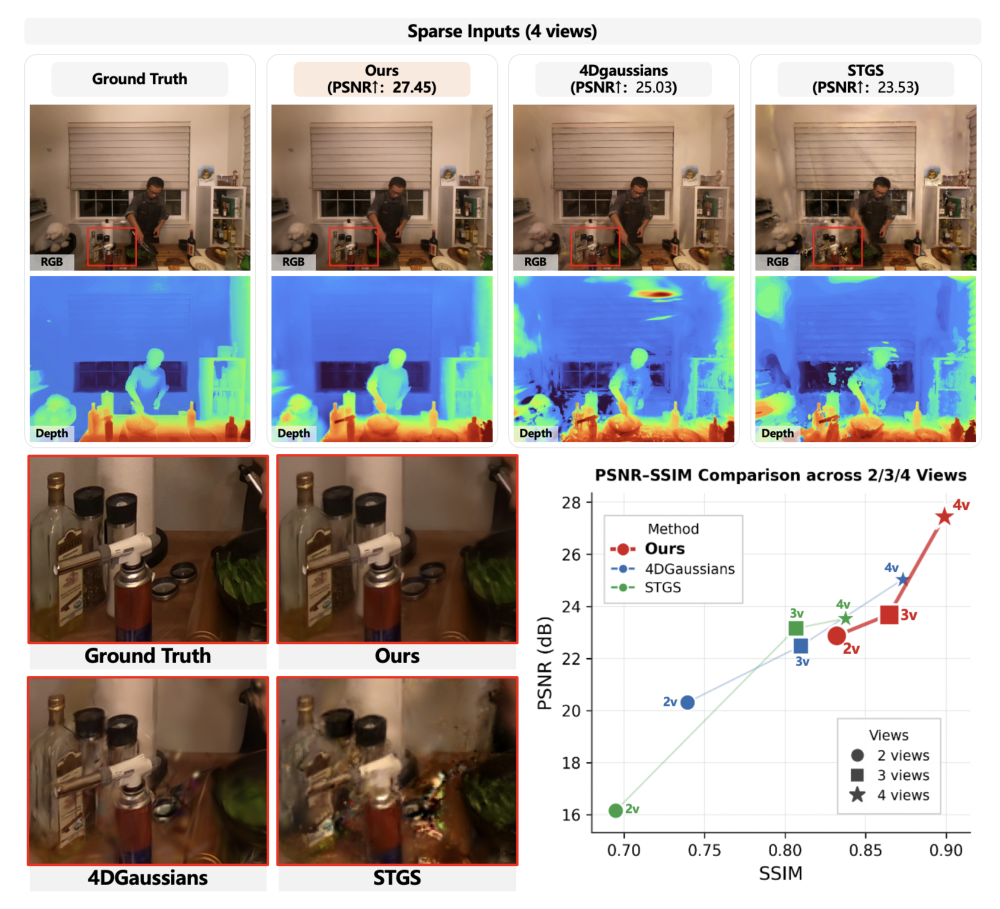
研究动机
Dynamic 4DGS 通常依赖密集、同步的多相机视频。相机数量减少以后,RGB supervision 很难唯一确定动态场景的 3D geometry:错误位置的 Gaussians 仍然可能解释有限 training views,最终产生 missing structures、foreground/background blending 和 floating primitives。
引入 depth prior 是自然选择,但 D²-4DGS 认为 单一 depth source 都不够:
- Monocular depth:coverage 稠密,但 scale ambiguous,而且存在局部 bias;
- Multi-view geometric depth:与 reconstruction coordinate system 一致、几何可靠性更高,但在 occlusion、weak texture、limited baseline 和动态区域中 coverage 很差。
论文真正解决的问题不是“把两张 depth map 融合一下”,而是:
当两个 depth source 的可靠性和 coverage 完全不同,应该让它们在 4DGS optimization 中承担什么不同职责?
D²-4DGS 的答案很明确:先对齐,再做 cross-source verification,然后把 depth 分成不同 reliability level。
- 两种来源一致的 verified anchors:可以作为强几何证据,用于 pruning 和 depth supervision;
- 只有 monocular depth 的区域:只把它当作 densification proposal,用于提出“这里可能缺 surface”,但不直接强迫现有 Gaussians 拟合它;
- 两种来源冲突的区域:直接丢弃。
这种“不同置信度的 prior 承担不同优化职责”是整篇论文最重要的设计。
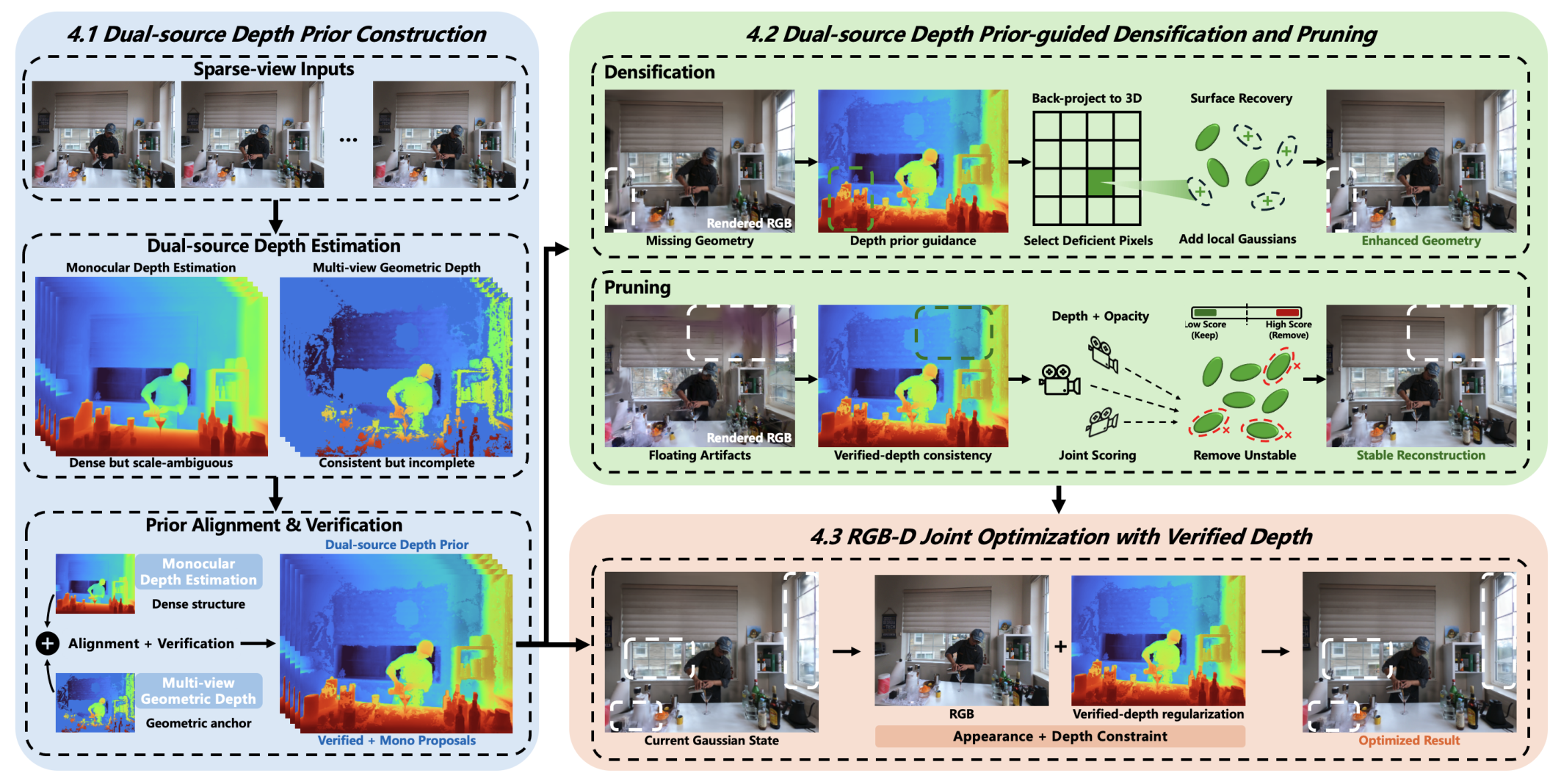
Fig. 2 的框架图把这条职责链画得很清楚:先并行获得 MDE 与 MVS,再做逐帧对齐和 cross-source verification,最后分别进入 densification、pruning 与 verified-depth RGB-D optimization。
核心方法
1. Dual-source Depth Prior Construction
对每个时间戳 $t$、相机 $n$:
- monocular depth $D^m_{t,n}$:Depth Anything V2 独立预测;
- geometric depth $D^g_{t,n}$:在同一 timestamp 的同步相机之间运行 COLMAP PatchMatch Stereo。
这里 不会跨时间做 MVS,因此避免把动态物体在不同时间的位置混在一起。
COLMAP 自带 geometric-consistency filtering,先得到有效 geometric depth mask $M^g_{t,n}$。
2. 用 geometric depth 对齐 monocular depth
对于每帧、每个 view 独立拟合 positive scale $a{t,n}$ 和 shift $b{t,n}$:
其中使用 Charbonnier penalty:
对齐后的 monocular depth:
注意这里是 逐帧、逐相机独立 scale-shift calibration,不是一个 sequence-level global alignment。它解决的是“先把 MDE 放进 reconstruction coordinate system”,但本身不保证跨视角局部几何一致。
3. Cross-source Verification
在同时具有 MVS depth 的位置,计算相对 discrepancy:
只有满足
的像素才进入 verified region $\Omega^v_{t,n}$。
最终 dual-source prior 定义成分段形式:
这一式子就是论文的核心:
- verified overlap:相信 geometric depth;
- MVS 没覆盖:允许 aligned MDE 补 coverage;
- MVS 和 MDE 同时存在但冲突:谁都不信。
更关键的是,后续模块不会对这两类有效 depth 一视同仁。
4. Depth-guided Densification
3DGS/4DGS 可以渲染当前 depth:
其中 $w_i=T_i\alpha_i$ 是 front-to-back compositing weight,$A=\sum_iw_i$ 表示该 pixel 是否已有足够 Gaussian contribution。
如果当前 rendered depth 无效,或者与 prior 差异很大:
则认为这里是 under-reconstructed region。
对应 pixel 被按照 $D^*$ back-project 到 3D,作为新 Gaussian center 的候选:
这一步允许 mono-only depth 参与。理由是:densification 的角色只是提出“这里可能需要补一个 primitive”,后续 RGB 和多视角优化仍有机会修正它;因此可以容忍更高的不确定性。
5. Consistency-aware Pruning
Pruning 则更谨慎,只使用 verified anchors 对现有 Gaussian 做几何判断。
对 Gaussian $g_k$,作者计算它在 verified pixels 上的 contribution-weighted depth inconsistency:
再归一化为 $E_k\in[0,1]$。
同时计算 visibility-aware opacity contribution $O_k$,最后得到 pruning score:
含义是:
- depth inconsistent:几何位置可疑;
- opacity contribution 小:对 rendering 也不重要。
只有高 pruning score 连续多次出现时才真正删除 Gaussian,避免一次 noisy observation 就误删有效结构。
6. Verified-depth RGB-D Joint Optimization
Depth loss 也只在 verified prior + valid rendered depth 同时存在的位置计算:
总目标:
因此 mono-only depth 从不直接进入 depth loss。它只负责 densification proposal;强监督和 pruning 都必须经过 multi-source verification。
数据集
论文评测三个 dynamic novel-view synthesis benchmark:
- N3DV:6 scenes;
- Technicolor:5 scenes;
- ENeRF-Outdoor:3 scenes。
每个数据集都测试 2 / 3 / 4 camera sparse-view settings。只有指定 cameras 用于训练,其余有效 cameras 全部作为 held-out novel views。
评价指标包括 PSNR、两种 data range 下的 SSIM,以及 LPIPS。
算力
所有实验使用 单张 NVIDIA RTX 4090 24GB。
论文明确指出,dual-depth preprocessing 与周期性的 Gaussian structure updates 会增加训练时间,但正文没有给出像 StereoGS 那样完整的 per-scene minutes 对比表。
因此可以确认单卡 4090 可运行,但不能据此认为方法训练代价与原始 4DGS 相同。
实验结果
1. 九种 dataset-view setting 的主结果
D²-4DGS 在 N3DV、Technicolor、ENeRF-Outdoor 的 2/3/4-view 共 9 个设置中都取得最高 PSNR。论文报告相对于每个设置中最好的 competing method,平均提升约 1.33 dB。
例如 4-view:
- N3DV:24.9534 PSNR;
- Technicolor:29.1182 PSNR;
- ENeRF-Outdoor:22.0253 PSNR。
2-view 时优势尤其明显,因为此时 RGB cross-view constraint 最弱,错误 Gaussian 最容易在 training views 上过拟合。
Table 1 的完整九组结果说明,这个收益并非只出现在某一个数据集或某一个相机数量;从 2-view 到 4-view,dual-depth 仍然稳定改善 sparse-camera novel-view synthesis。
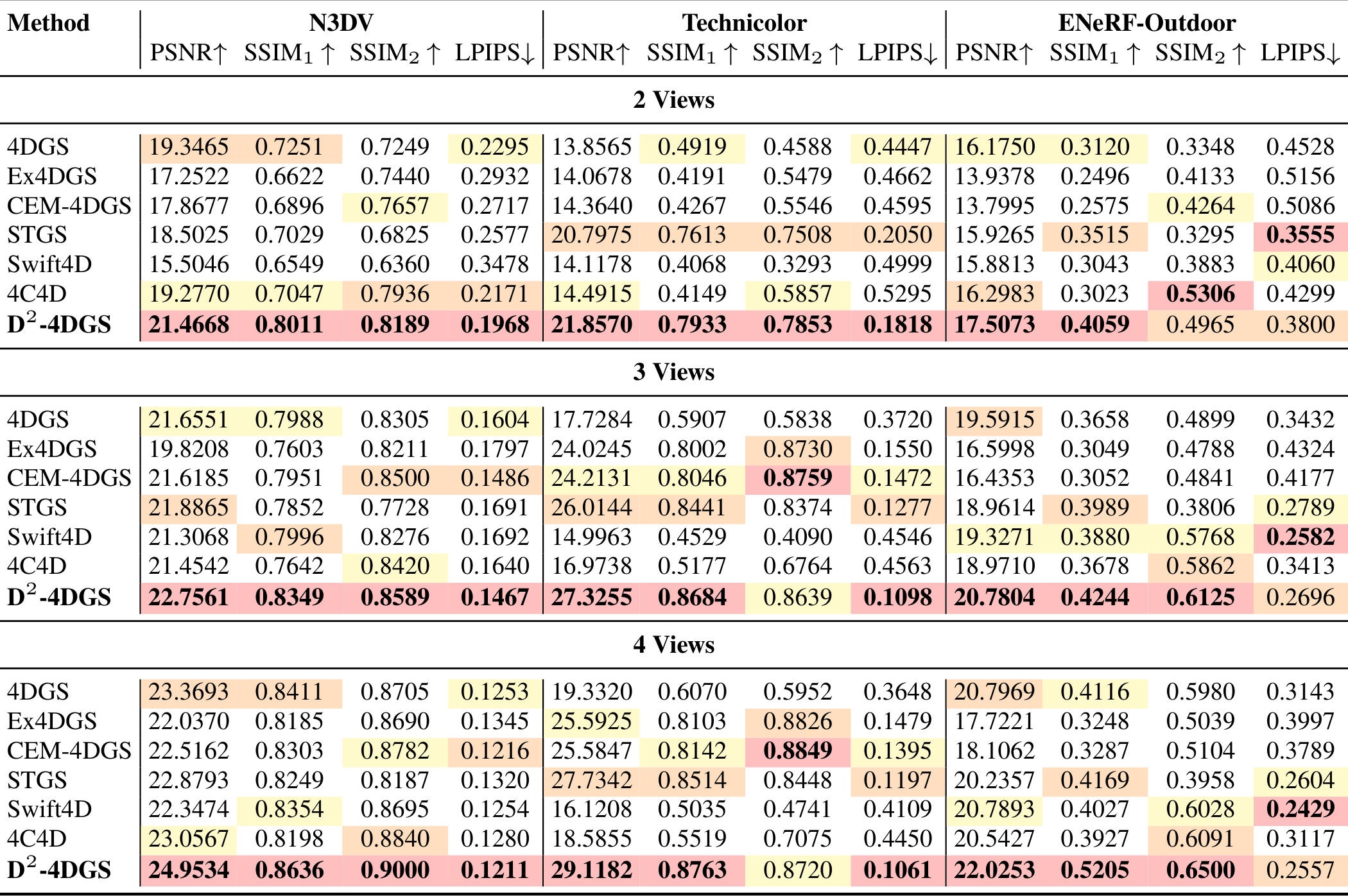
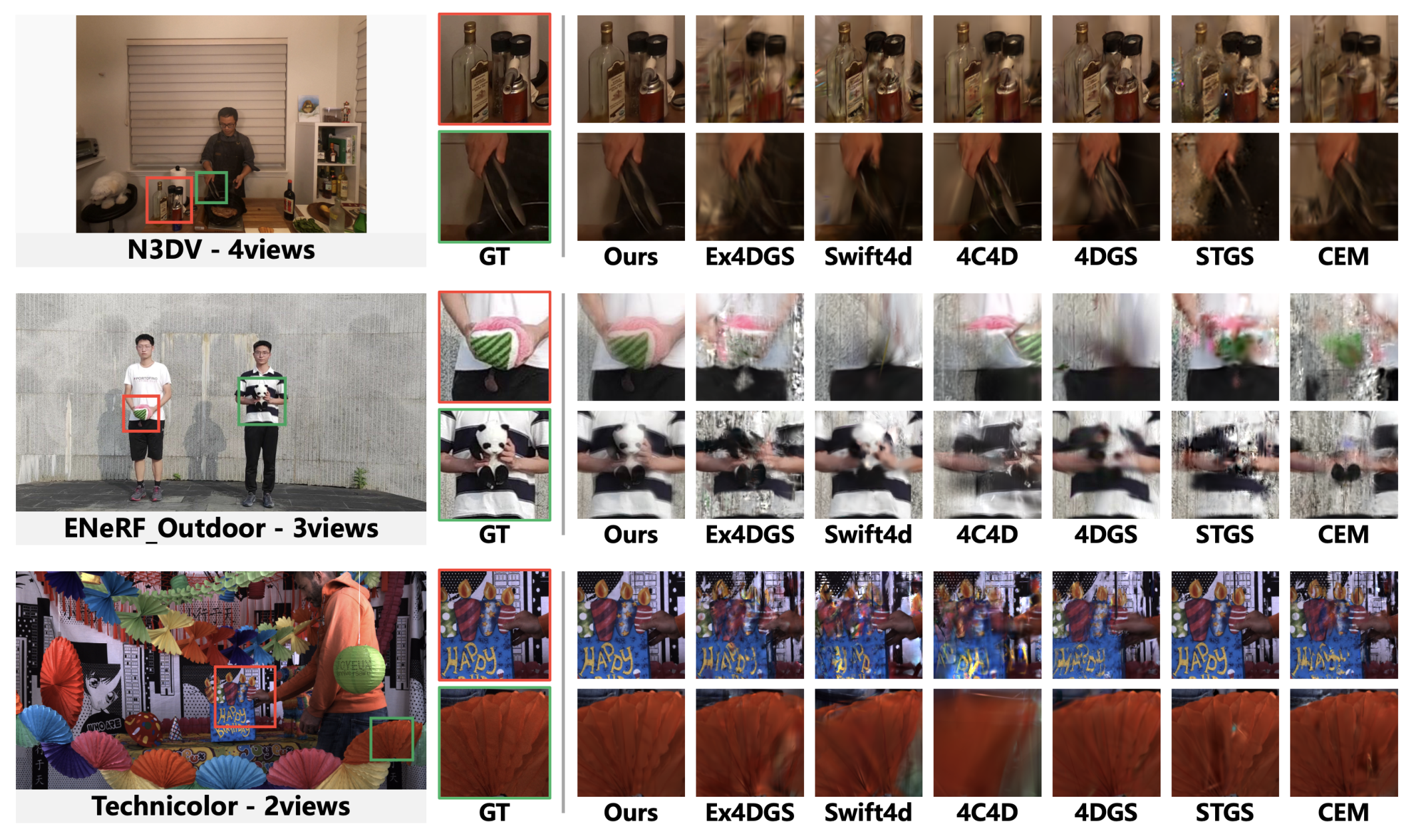
Fig. 3 的定性结果进一步显示,完整方法能减少动态物体边界的 floating primitives、foreground/background blending 和缺失结构;这与数值上的 PSNR 提升是同一个几何改进的两种表现。
2. 单一 prior 与 dual prior
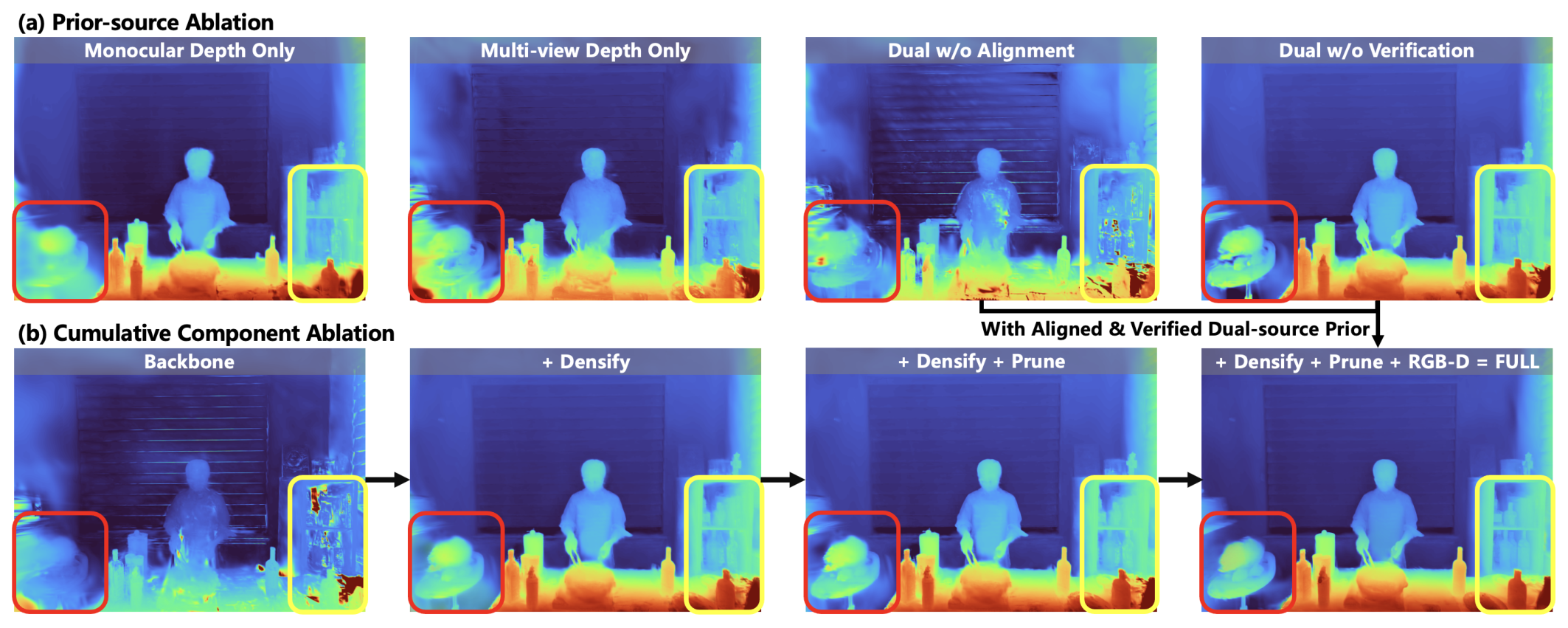
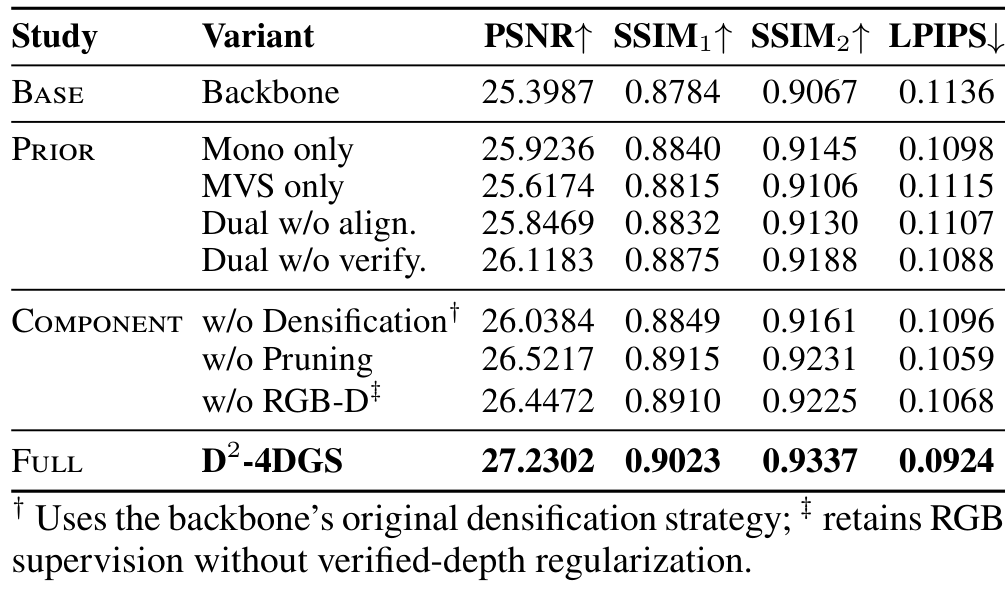
在 N3DV sear_steak 4-view ablation 中:
- Backbone:25.3987 PSNR;
- Mono only:25.9236;
- MVS only:25.6174;
- Dual w/o alignment:25.8469;
- Dual w/o verification:26.1183;
- Full D²-4DGS:27.2302。
这组结果说明:
- 单目和 MVS 单独用都有帮助;
- Mono-only 比 MVS-only 更强,说明 sparse dynamic setting 中 dense coverage 很重要;
- 但简单把两种 prior 拼在一起仍然达不到 full model;
- alignment + verification 才是 dual-source fusion 真正有效的前提。
Fig. 4 的可视化消融说明,去掉 alignment 或 verification 后,depth prior 会在局部动态区域留下明显错误;full model 则把冲突区域排除在强监督之外。
3. Densification、Pruning、RGB-D 哪个最重要?
同一场景:
- w/o proposed Densification:26.0384;
- w/o Pruning:26.5217;
- w/o RGB-D depth regularization:26.4472;
- Full:27.2302。
移除 densification 的下降最大。这说明 sparse-camera dynamic reconstruction 的首要问题之一不是“已有 geometry 不够精”,而是 某些 surface 根本没有被表示出来。
这与 MDE 的优势非常契合:MVS 在弱纹理/遮挡处可能没有 depth,而 dense monocular prediction 至少能提出 missing-surface candidate。
Table 2 将 densification、pruning 和 RGB-D depth regularization 的组合放在一起比较。它支持一个重要的分工判断:densification 负责补上未表示的 surface,pruning 负责清除可疑结构,RGB-D supervision 再负责把保留下来的 geometry 拉回正确位置。
4. Pruning signal
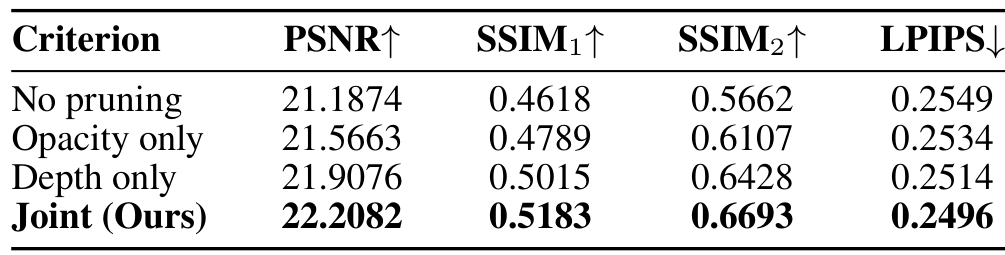
在 ENeRF-Outdoor actor5_6:
- No pruning:21.1874 PSNR;
- Opacity only:21.5663;
- Depth only:21.9076;
- Joint:22.2082。
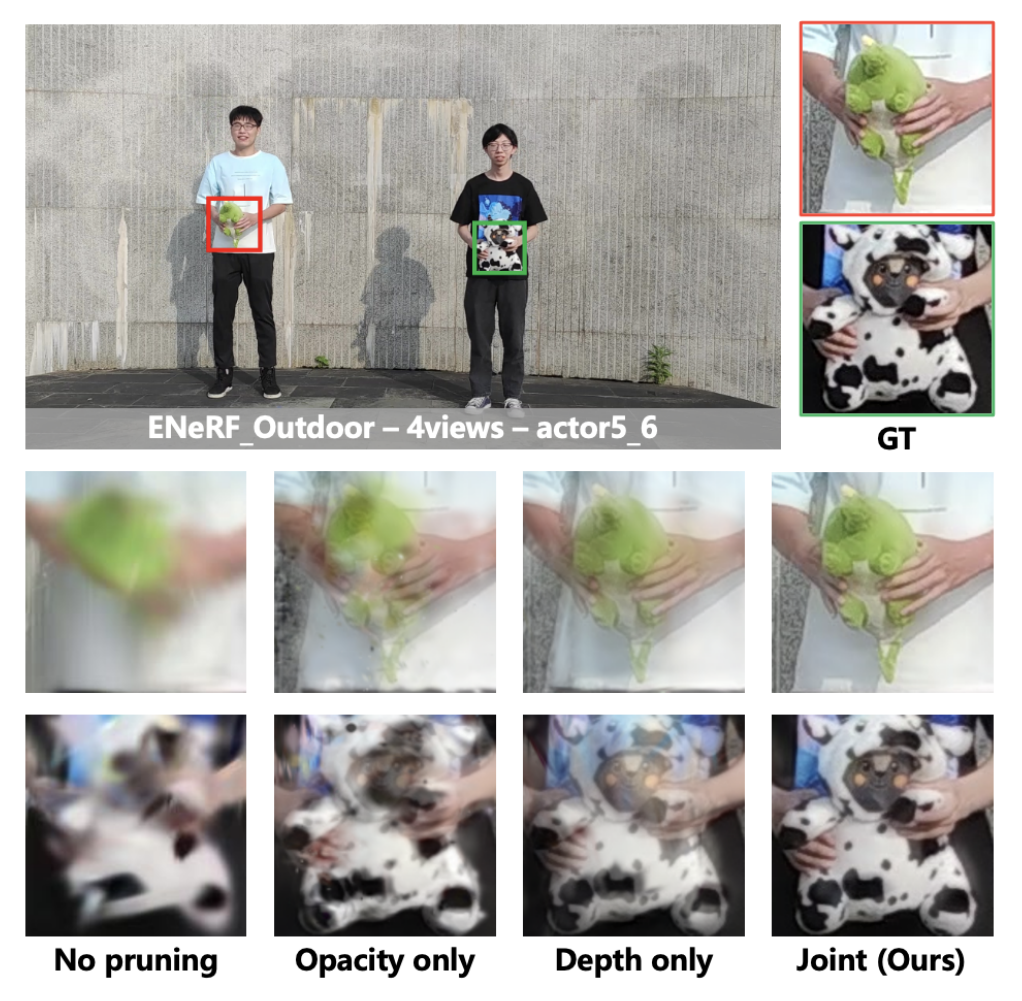
Depth inconsistency 比 opacity contribution 单独更有信息,因为一个 Gaussian 即使 photometric contribution 很强,也可能位于错误 depth;两者结合最好。
Table 3 与 Fig. 5 共同说明,pruning signal 需要同时观察 depth inconsistency 和 visibility-aware opacity contribution:只看其中一个信号,都会留下更多错误或低价值 Gaussians。
优势与不足
优势
- 最大优点不是“用了两种 depth”,而是 按可靠性给不同 prior 分配不同权限。
- MDE 的 dense coverage 被用于结构补全,但不会在未经验证区域直接变成强监督,避免把 MDE error 硬写进 4D geometry。
- Prior 不只作为 loss,还直接控制 Gaussian densification 和 pruning,真正改变 representation structure。
- 消融完整地证明 alignment、verification、densification、pruning、RGB-D supervision 都有独立贡献。
不足
- Monocular depth 的校准仍然是逐帧 scale-shift;如果 MDE 存在 spatially varying local bias,这个 global affine alignment 本身不能修正。
- 在 MVS 完全缺失的区域,densification 只能依赖 aligned monocular depth。论文也承认较大的 MDE error 会降低 structural completion accuracy。
- 方法需要同步、已标定的 sparse multi-camera video,适用条件比普通单目视频 4D reconstruction 更严格。
- Dual-depth preprocessing 和 structure update 增加训练成本,而且没有引入额外 temporal motion prior;动态几何的一致性主要仍依赖原 backbone。
记忆点
- 不同 reliability 的 depth prior 不应该拥有相同的优化权限。
- Verified MDE-MVS overlap → pruning + depth supervision;Mono-only → densification proposal;Conflict → discard。
- 对 sparse-view 3DGS/4DGS,prior 的作用不应该只设计成一个 depth loss,还可以直接决定 在哪里新增 Gaussian、删除哪些 Gaussian。
- Densification ablation 的下降最大,说明 sparse reconstruction 的关键瓶颈之一是 missing geometry,而不只是已有 surface 的位置误差。
- 对单目深度下游研究最值得追问的是:D²-4DGS 用 MVS verification 给 MDE 分配可信度,但仍没有解决 MDE 自身的 spatial local bias 与 cross-view inconsistency。这正是可以继续深入的空间。
 微信
微信 支付宝
支付宝