MoRe: Monocular Geometry Refinement via Graph Optimization for Cross-View Consistency
作者: Dongki Jung, Jaehoon Choi, Yonghan Lee, Sungmin Eum, Heesung Kwon, Dinesh Manocha
单位: University of Maryland, College Park;DEVCOM Army Research Laboratory
会议: WACV 2026
研究动机
MoRe 讨论的是一个非常直接的下游问题:单目 3D foundation model 单帧预测很好,但把多个视角的 point map 放到同一个世界坐标系后,为什么仍然对不齐?
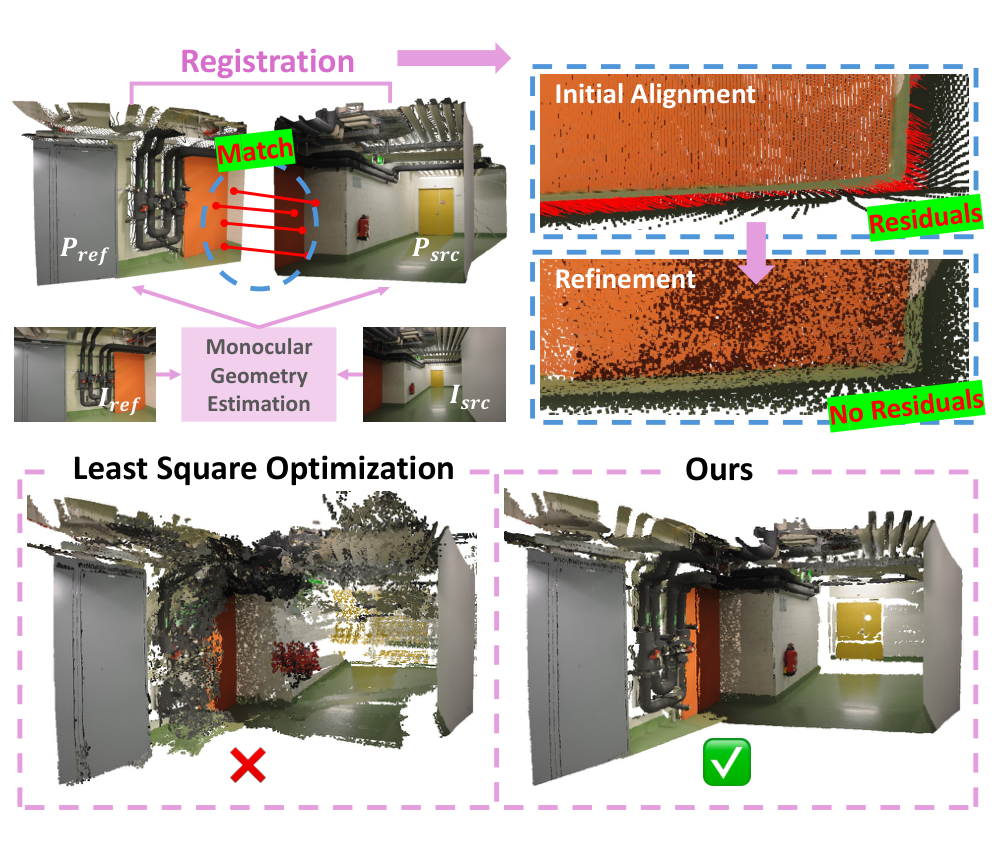
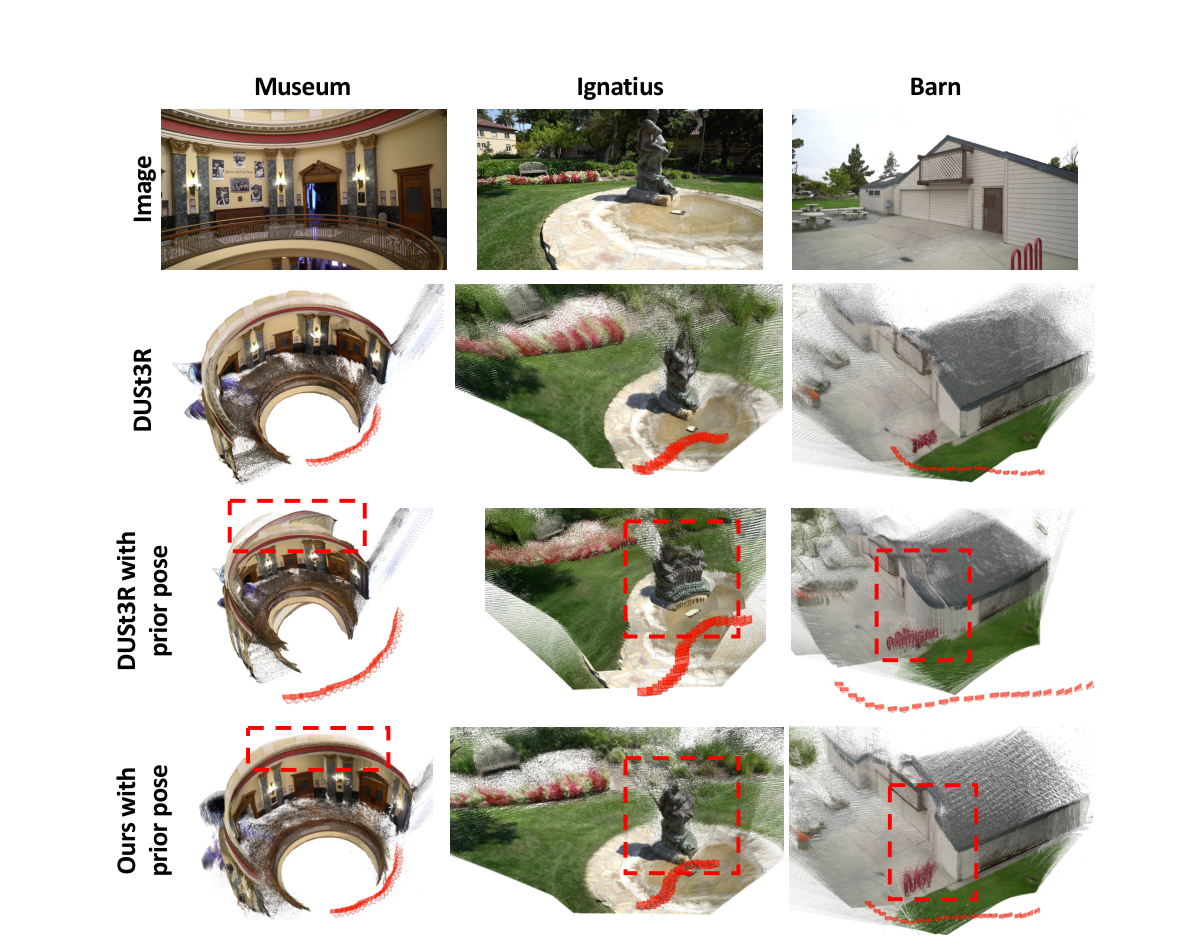
以 MoGe 为代表的 monocular geometry model 可以预测细节丰富的 point map 和 normal,但每一帧都是独立推理。即使 camera pose 已知,把各视角 point map 变换到共同坐标系后,仍然会受到 monocular affine ambiguity、局部形状误差和跨视角不一致的影响。结果就是:
- 同一真实表面在不同视角下形成多个平行或错位的表面;
- feature correspondence 对应的 3D points 仍有明显 residual;
- 直接做 global scale/shift 可以改善整体位置,但不能消除像素级几何残差;
- 简单最小化 matched 3D points 的 Euclidean distance 又容易被 noisy correspondence 拉坏。
MoRe 的核心判断是:
跨视角 alignment 不能只看“对应点应该重合”,还应该利用 point map 本身已经给出的局部 surface geometry。
因此作者没有训练新的 multi-view network,而是把 monocular point map 当作可优化的显式几何变量,通过 feature matches 建立 inter-frame graph,再用 local planar approximation、surface normal、camera ray 等传统几何约束做 training-free refinement。
这篇论文最值得关注的地方在于:它把“单目深度/point map 到多视角重建”的问题,从 global scale alignment 推进到了 pixel-level 3D geometry optimization。
核心方法
1. 输入与总体流程
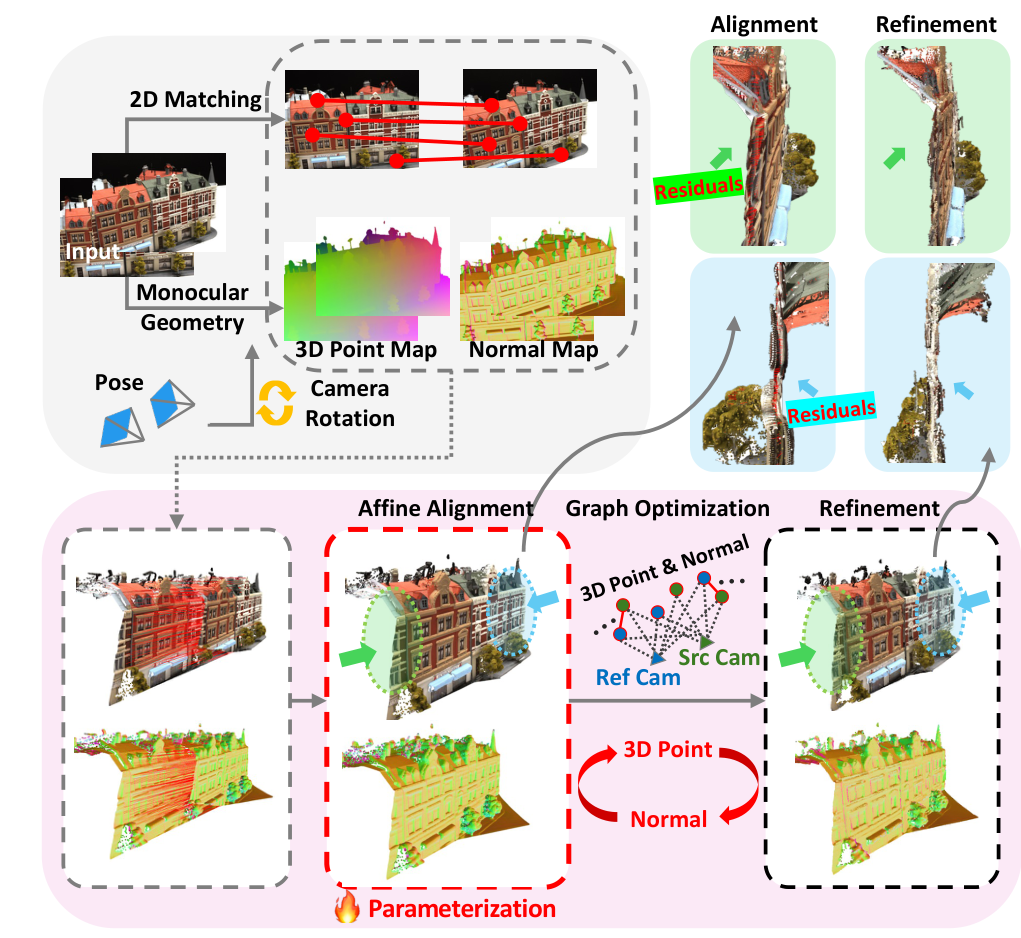
给定 reference/source images,MoRe 首先使用 monocular 3D foundation model $F_\theta$ 独立预测 point maps:
同时使用 dense image matcher 得到像素对应关系:
之后分两步:
- Initial Alignment:先解决大尺度的 scale/shift ambiguity;
- Graph Optimization:直接优化 3D point map 和 surface normals,消除 local residual。
作者默认使用 MoGe 作为 monocular geometry prior,但方法本质上是一个后处理框架。
2. Case 1:有 camera pose 时的 affine alignment
如果外部 camera pose 已知,先把不同视角的 point maps 变换到共同世界坐标。然后利用 matched points 解一个 scale + 3D shift:
其中 $\alpha$ 是 source view 的全局 scale,$\boldsymbol\beta\in\mathbb R^3$ 是 3D shift。
这一步只能做 coarse registration。论文的关键现象是:即使 matched points 在整体上已经靠近,局部 residual 仍然大量存在。 这正是后续 graph refinement 的动机。
3. Case 2:没有 pose 时使用 MadPose
当 camera pose 不给定时,MoRe 使用 MadPose 从 image matches 与 affine-invariant depth 中联合估计 relative pose、scale 和 depth shift。
作者还发现 MadPose 的 shift 有时会异常增大,压过 relative scale,导致 depth map 失真。因此将 shift 上界限制为有效 depth IQR 的 $0.5\times$,属于一个很实用的稳定化处理。
4. 核心:Local-Planar Graph Optimization
Initial alignment 后,作者把 3D points 看成 graph nodes,用“两个点是否可能属于同一个局部平面”构造 edges。
局部平面最基本的约束是:如果中心点及其邻域点属于同一局部 surface,那么邻域点相对中心点的位移在该点法向方向上的投影应接近 0,即
MoRe 将这个简单几何关系扩展成四类约束。
4.1 Intra-frame planar constraint
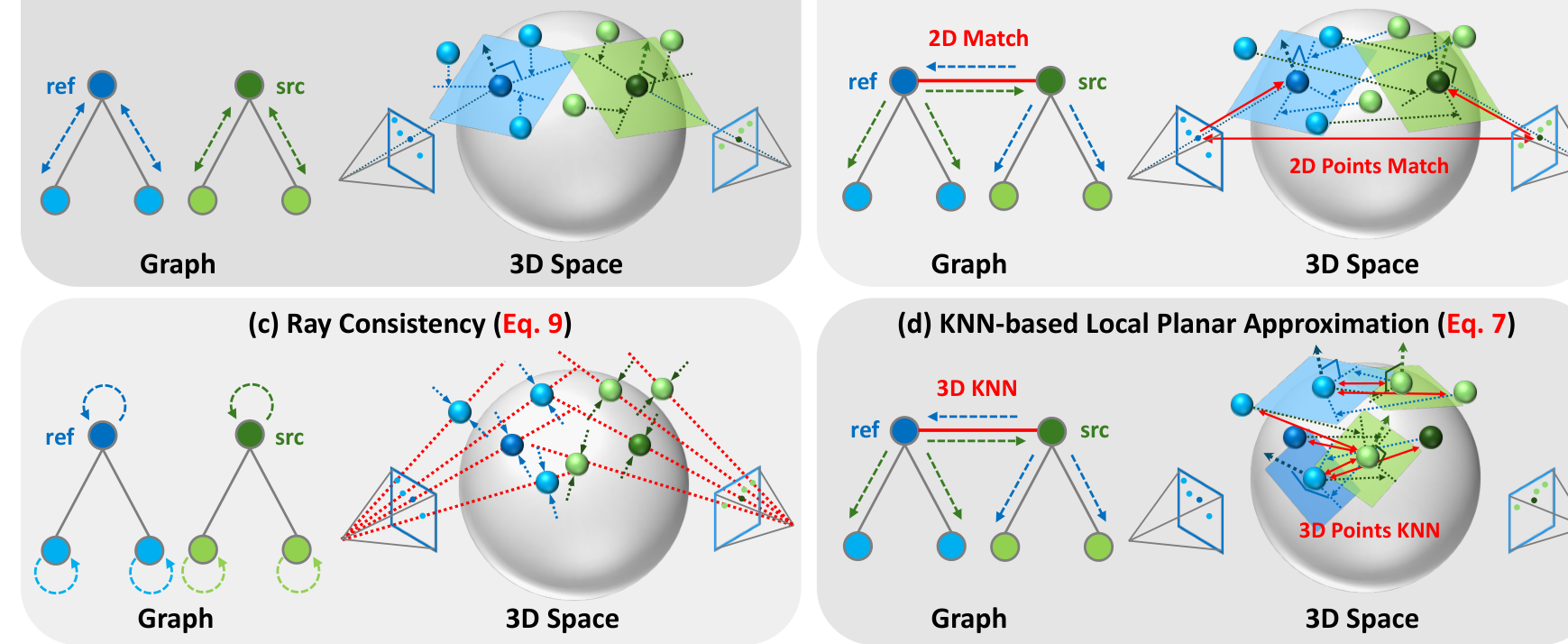
同一帧相邻像素之间保持局部共面,同时 normal 不应剧烈跳变:
它负责保留 monocular point map 原本较好的局部 surface structure,避免跨视角对齐把单帧几何拉散。
4.2 Inter-frame constraint
对 feature matcher 给出的对应点及其邻域建立跨视角平面约束。相比直接要求两个 matched 3D points 完全重合,local plane constraint 对 correspondence noise 更鲁棒,因为它允许点沿切平面方向有一定自由度,而重点惩罚偏离 surface 的法向误差。
这也是 MoRe 相比“matched points + least squares”的核心区别。
4.3 3D kNN constraint
2D matcher 只覆盖部分区域,不能保证所有 surface 都有跨视角 matches。因此作者在当前 3D point cloud 中做 cross-view kNN,给没有直接 feature match 的区域补充几何连接。
对应 loss 同时考虑:
- reference normal 下的 point-to-plane error;
- source normal 下的 point-to-plane error;
- 两侧 normal consistency。
默认使用 $k=4$。
4.4 Camera-ray constraint
MoRe 直接优化 xyz point coordinates,而不是只优化 depth。优点是 point 可以在三个方向移动,更容易消除 point-map 的横向偏差;风险则是优化后的 point 可能离开对应像素的 viewing ray。
因此加入:
本质上最小化 3D point 到原始 camera ray 的距离。
5. 防止 trivial solution
如果只优化上述跨视角几何,point cloud 可能整体塌缩或偏离 monocular prior。因此还加入:
- shape/scale regularization $L_s$:约束 refined geometry 与原 point map 保持 similarity-like structure;
- normal regularization $L_n$:约束 optimized normal 不要过度偏离输入 normal;
- confidence mask:只在 monocular model 较可信区域施加强 prior。
总目标为:
论文设置 $\lambda_p=30,\lambda_r=50,\lambda_s=0.1,\lambda_n=10$。
数据集
Multi-view depth / geometry evaluation:
- KITTI
- ScanNet
- ETH3D
- DTU
- Tanks and Temples
3D reconstruction:DTU。
Sparse-view novel-view synthesis:Tanks and Temples,按照 InstantSplat 类似设置,使用约 3/6/12 个 training views。
论文统一将测试图像最长边缩放到 512 pixels。
算力
MoRe 是 training-free optimization method,没有额外网络训练成本,但每组视角需要 test-time graph optimization。
作者使用 Adam 和 two-level multi-scale optimization:两个 level 各优化 50 iterations,学习率均为 $5\times10^{-3}$。
补充材料给出 L40S 上的运行量级:
- 512×377、5000 matches、kNN $k=4$:约 1.6 s / 838 MiB;
- 640×471:约 2.5 s / 1354 MiB;
- $k=16$:约 2.0 s / 1152 MiB。
因此它比重新训练网络便宜很多,但本质仍是 per-scene / per-pair iterative optimization,处理大量帧时扩展性会成为问题。
实验结果
1. Multi-view depth
在不提供 GT pose/depth range/intrinsics 的设置中,论文报告:
- DUSt3R:Average Rel 4.73,$\tau$ 64.52;
- MoRe:Average Rel 3.74,$\tau$ 64.48。
这里需要谨慎解读:MoRe 在平均 Rel 上明显更低,但 $\tau$ 与 DUSt3R 基本相当,并不是所有指标都全面领先。
Table 1 还把结果拆成不同的 pose、intrinsics 和 depth-range 条件:在没有 GT pose/depth range 的设定中,MoRe 的平均 Rel 为 3.74,说明 refinement 的收益并不依赖额外的 GT 深度范围。
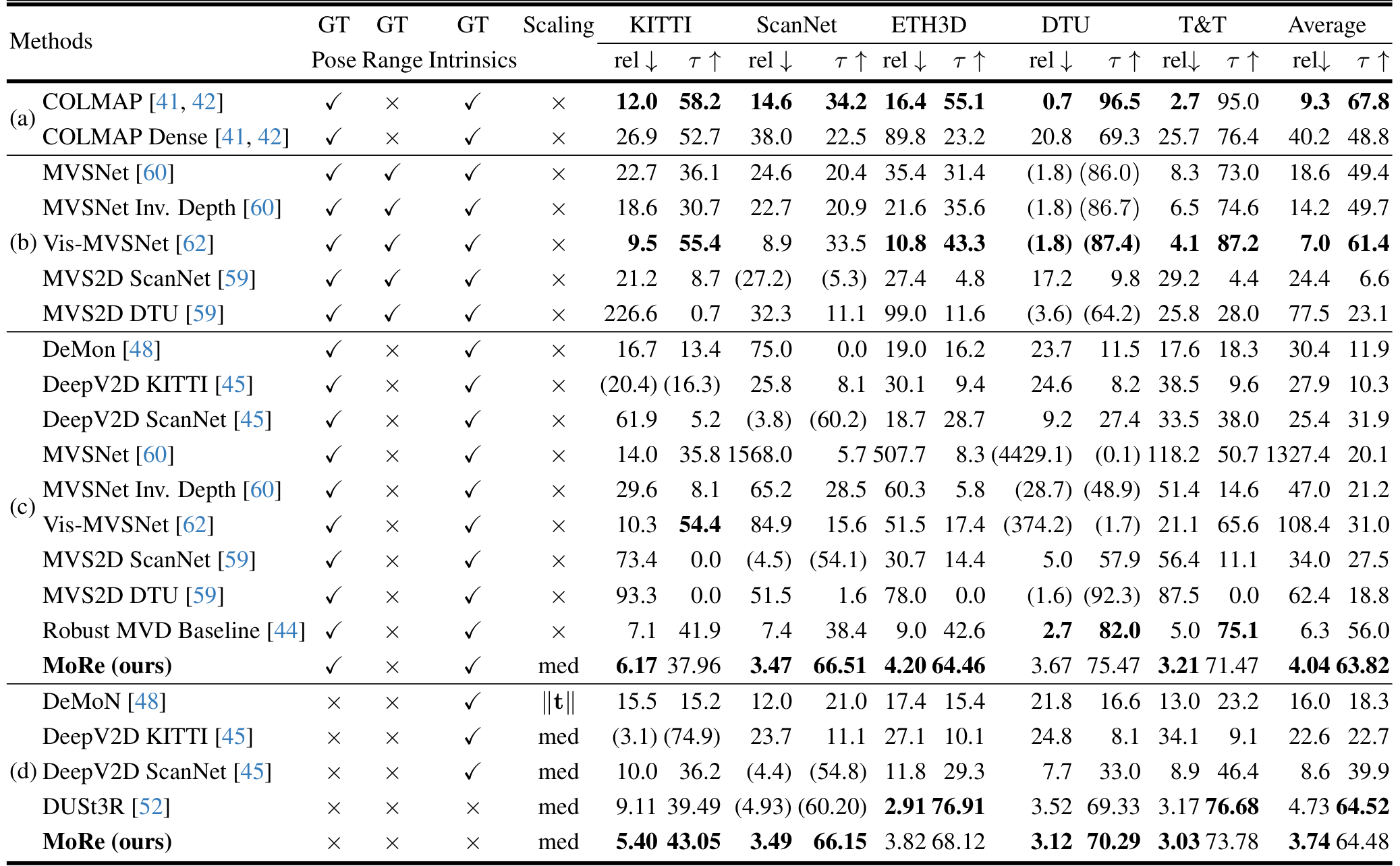
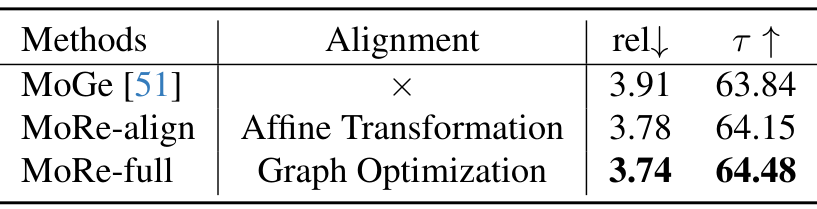
更重要的是 ablation:
- MoGe:Rel 3.91 / $\tau$ 63.84;
- MoRe-align:3.78 / 64.15;
- MoRe-full:3.74 / 64.48。
说明 global affine alignment 已能拿到大部分收益,而 graph optimization 进一步带来较小但稳定的 pixel-level refinement。这一点很有研究价值:global scale/shift 确实不是终点,但 local refinement 的增量收益相对更细。
2. DTU 3D Reconstruction
MoRe 在 DTU zero-shot reconstruction 中取得 Acc. 2.202、Comp. 1.352、Overall 1.777。它没有超过针对 DTU 训练的经典 MVS 方法,但在使用相同 GT camera 参数的比较下优于论文中的 DUSt3R variant。
Table 2 的分组结果也应一起看:MoRe 的 zero-shot 行为是 Acc. 2.202、Comp. 1.352、Overall 1.777;它并没有超过针对 DTU 训练的传统或 learning-based MVS 方法。
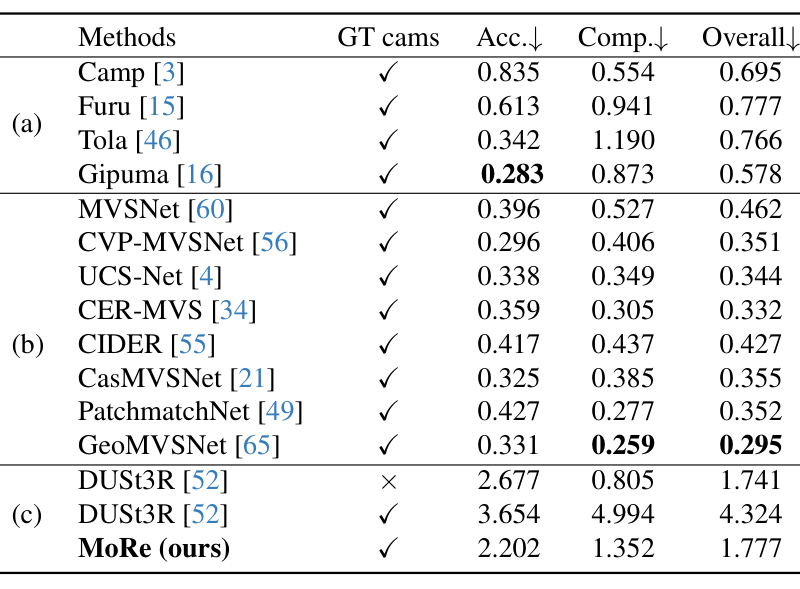
Figure 4 的可视化显示,MoGe 的单帧 depth 细节可以保留,但直接合并的 point cloud 会出现跨视角错位;MoRe 在保持细节的同时让 3D 点云更一致。
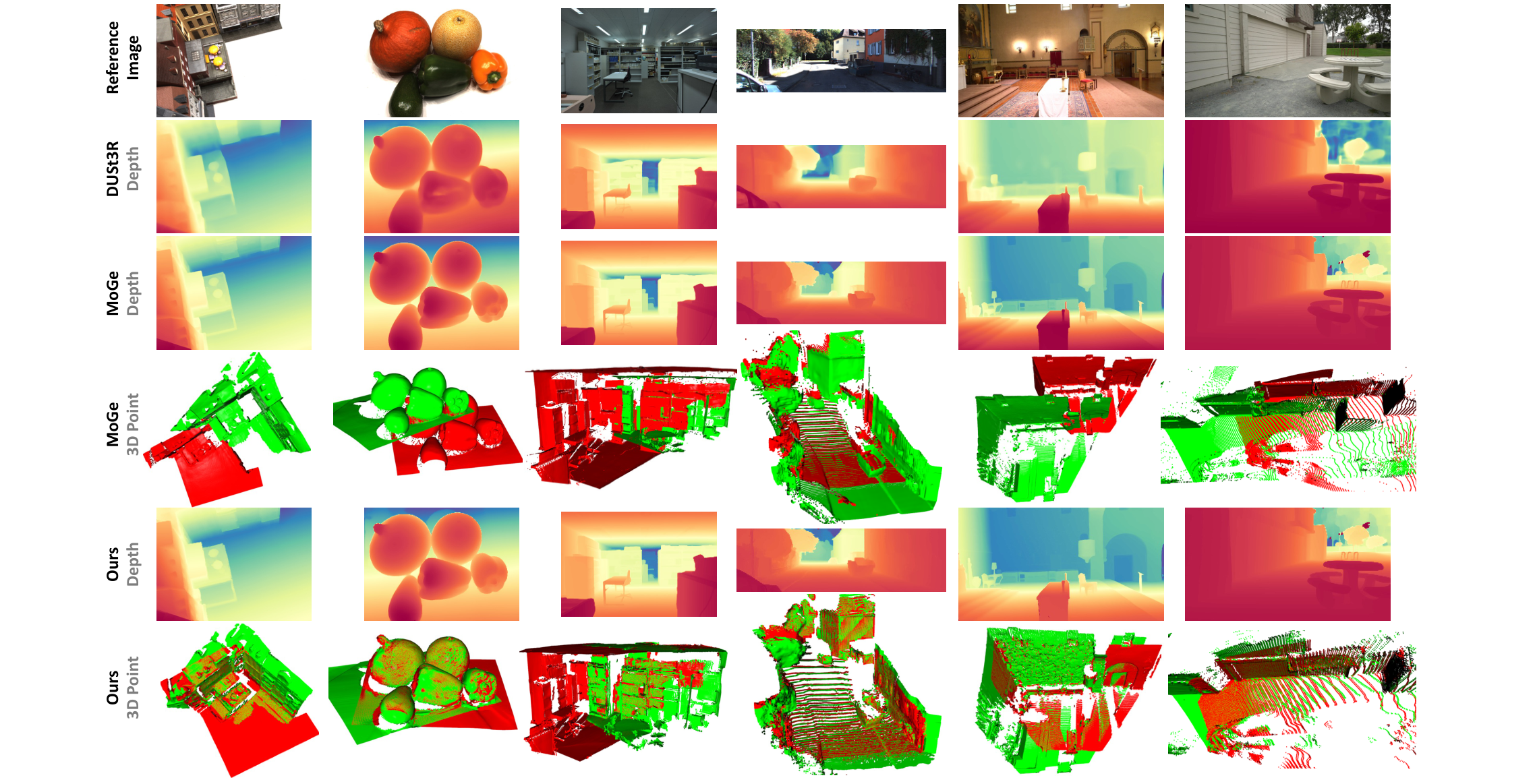
因此这部分更支持“monocular foundation geometry 可以通过显式几何优化变成可用的 multi-view initialization”,而不是证明 MoRe 已替代专门 MVS。
3. Sparse-view 3DGS initialization
作者把 refined point maps 作为 3DGS dense initialization,并跳过常规 densification,用 novel-view synthesis 检查几何 initialization 是否真的更好。
在 Tanks and Temples 的 3-view 设置、200 optimization steps 下:
- DUSt3R initialization:PSNR 13.77;
- Ours-align:17.99;
- Ours-full:18.48。
1000 steps 后 Ours-full 达到 19.93 PSNR,而 DUSt3R 为 14.10。
Table 4 和 Figure 5/6 共同说明了下游效果:Ours-full 在 200 steps 的 3-view PSNR 为 18.48,1000 steps 为 19.93;可视化中 refined pointmap 作为初始化后,结构比 DUSt3R、EDGS 或仅 affine alignment 更稳定。
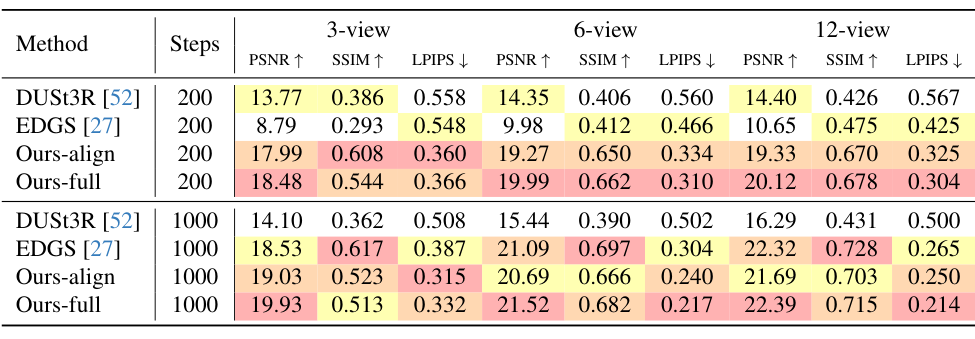
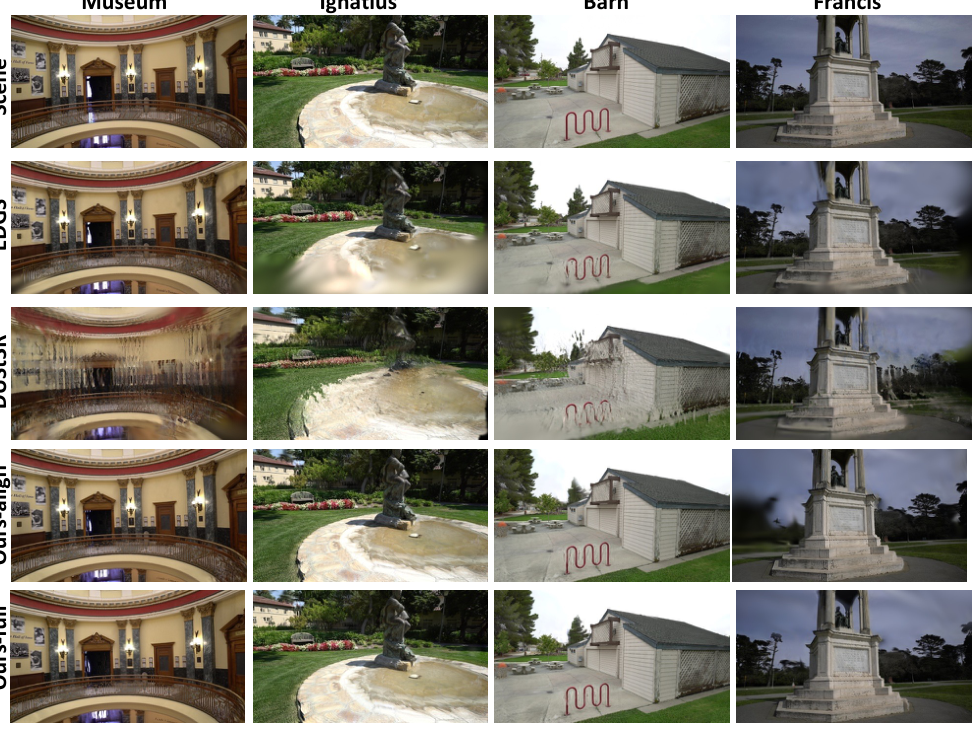
这说明 MoRe 的价值不只体现在 depth metric,而是 更一致的 initial geometry 能显著改变后续 3DGS 的优化起点和收敛速度。
不过 graph optimization 相比仅 affine alignment 的提升并没有初始化整体提升那么大,因此不能把所有收益都归因于复杂 graph loss。
Table 3 的消融也支持这个判断:MoGe 到 MoRe-align 已经把 rel 从 3.91 降到 3.78,加入 graph optimization 后进一步到 3.74;图优化更像是在已有 affine alignment 上完成最后一段局部一致性修正。
优势与不足
优势
- 训练自由,能直接把现有 monocular geometry foundation model 当作模块使用。
- 把 global scale/shift 对齐之后仍然存在的 residual 明确建模为 pixel-level 3D geometry refinement。
- 不仅依赖 sparse correspondence,还利用 local plane、normal、3D kNN 和 ray constraint,让优化具有明确几何含义。
- 下游 3DGS 实验证明“单帧指标”和“作为 3D initialization 是否好用”确实是两个不同评价维度。
不足
- graph optimization 是 iterative test-time optimization,多帧增量处理的计算复杂度较高,论文自己也将 scalability 列为 limitation。
- local planar approximation 假设对曲面、细结构、复杂动态物体并不总成立,虽然 edge weight 与 normal 能缓解,但不能完全消除模型偏置。
- 3D kNN 是基于当前几何寻找邻居。如果 initial alignment 本身错得很大,错误近邻可能反过来强化错误结构。
- 从 ablation 看,affine alignment 已经贡献大部分 depth 指标提升;graph refinement 的收益更像“最后一公里”,需要结合更严格的 reconstruction metric 判断成本是否值得。
记忆点
- Global scale/shift 只能解决 coarse registration,不能保证同一 3D surface 在多视角中真正重合。
- 对 noisy correspondence,与其强迫 matched 3D points 点对点重合,不如使用 point-to-local-plane 约束。
- 直接优化 xyz 比只优化 depth 自由度更高,但必须配合 camera-ray constraint 防止 point 离开原像素射线。
- 2D matches 负责建立可靠跨视角关系,3D kNN 负责补 coverage,这是一种“稀疏可靠 + 稠密扩展”的图构造方式。
- 对单目深度进入 3DGS 的问题,MoRe 最重要的启示是:应直接评估多视角投影后的 3D 分布/残差,而不是只关注每帧 depth metric。
 微信
微信 支付宝
支付宝